

ACADEMICS
An Oldfields education is designed as a coherent intellectual journey rather than a collection of isolated courses. Across disciplines, students are asked to attend carefully, ask worthwhile questions, investigate evidence, test ideas, reflect on what they have learned, and transfer those habits into new settings. As students progress, they move from guided practice toward greater independence, judgment, and ownership of their learning.
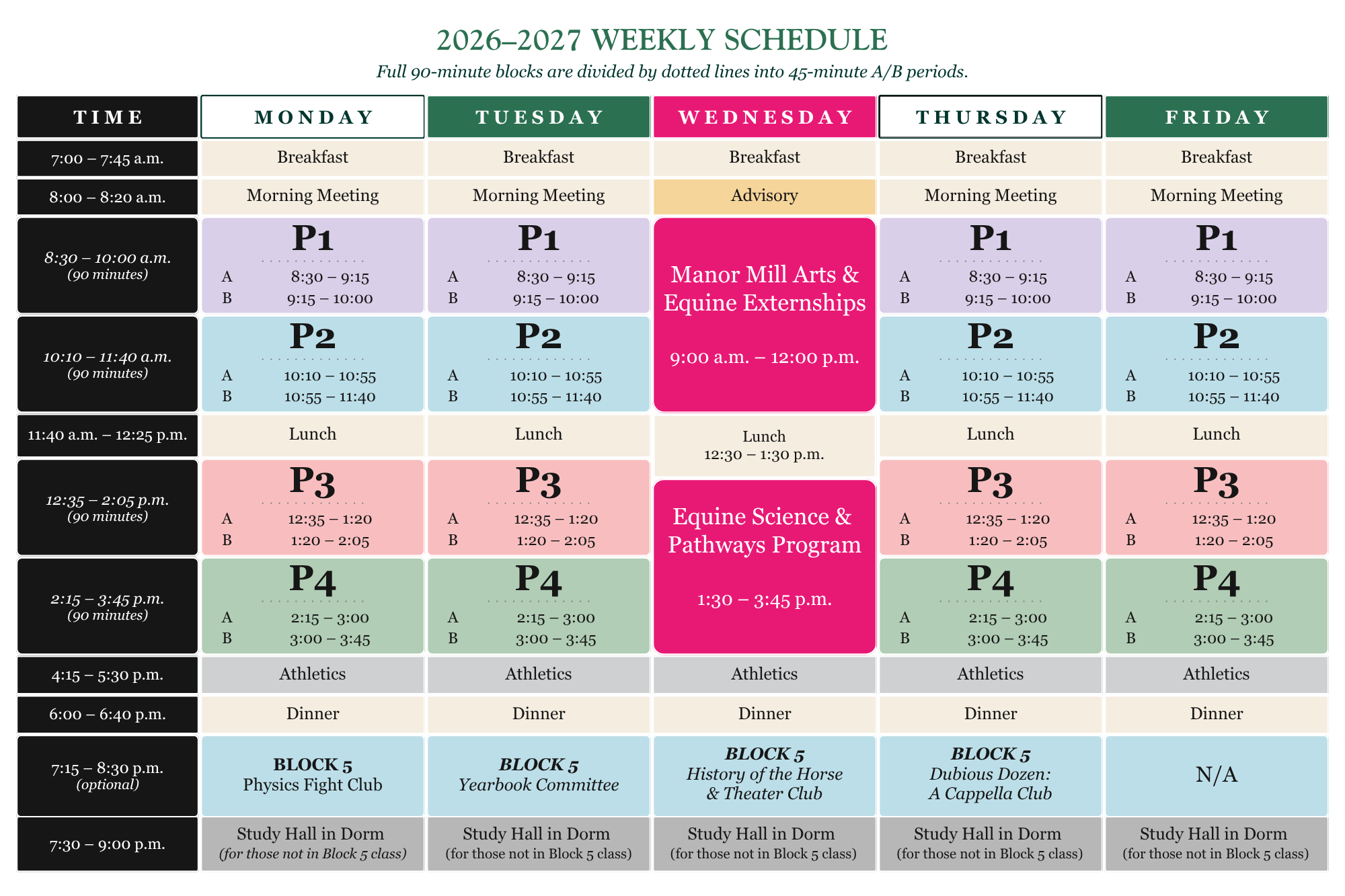
OLDFIELDS CURRICULUM
-
English courses develop students as attentive readers, purposeful writers, and thoughtful participants in conversation. Students learn to interpret language in context, recognize how form and rhetoric shape meaning, and write with increasing clarity, flexibility, and independence for a range of audiences and purposes.
COURSES
English 9
The English Department program begins by helping ninth-grade students develop the habits that will sustain serious reading, thoughtful discussion, and clear writing throughout their time at Oldfields. Students learn not simply how to complete assignments, but how to attend closely to a text, ask worthwhile questions, enter into meaningful conversation, and shape their ideas with increasing precision and confidence.
English 10
In English 10, students encounter readings that ask them to engage with increasingly complex questions about identity, relationships, society, and the world around them. Writing moves across a range of forms—including personal narrative, essays, letters, editorials, poetry, and responses to literature—so that students learn to adapt their voice to different purposes and audiences. Throughout the course, emphasis is placed on perspective: understanding how writers shape a reader’s experience, considering viewpoints beyond one’s own, and learning to express ideas with greater clarity, nuance, and intention.
English 11
In English 11, writing shifts increasingly from personal narrative toward analysis, asking students to develop, test, and articulate ideas with greater independence. As students work with more complex texts, they learn to let questions and arguments shape the structure of their writing rather than simply fitting ideas into a predetermined form. A significant portion of the course approaches the humanities through the lens of American history, inviting students to consider how literature both reflects and challenges the nation’s evolving self-understanding. Throughout the year, students wrestle with enduring questions of American identity: What does it mean to be free? Who gets to define the American experience? And how has the idea of the frontier shaped the country’s imagination, aspirations, and contradictions?
English 12
English Language and Composition
COLLEGE-LEVEL COURSE
English Language and Composition is an introductory college-level composition course. It cultivates the reading and writing skills that students need for college success and for intellectually responsible civic engagement. The course guides students in becoming curious, critical, and responsive readers of diverse texts and becoming flexible, reflective writers of texts addressed to diverse audiences for diverse purposes. The reading and writing students do in the course should deepen and expand their understanding of how written language functions rhetorically: to communicate writers’ intentions and elicit readers’ responses in particular situations.
This course will require students to exercise the independence, responsibility, and intellectual proficiency that college-level work demands. It is designed to prepare students for the demands of a college course and the continual necessity to be clear communicators in all facets of life. Students have the opportunity to demonstrate their mastery of college-level rhetoric on the AP Language and Composition exam in May. As with AP courses, additional assignments should be expected over school breaks and vacations.
Prerequisite: Recommendation from current English teacher and Department Chair approval
ELECTIVES
Banned Books: Literature, Censorship, & Society
SINGLE-SEMESTER COURSE
What should you be “allowed” to read? Who gets to decide this? Over history, who has made these decisions? Why? This class will read and discuss books that have been banned at some point in time. In tandem with these readings, students will discuss censorship and freedom. The class will dialogue in order to decide whether censorship is ever justified and how the history of censorship has shaped many societies.
Travels, Journeys, and Voyages in Literature
SINGLE-SEMESTER COURSE
In this class, we will focus on how, when, where, and why characters move. We’ll explore mostly fictional accounts of characters who must travel into and through a variety of nationalities and cultures. We’ll ask questions such as “What are the cultural and historical factors that necessitate these moves?” “What is the effect on the people involved?” and “What role does family play in these types of decisions?” This course will be discussion-based. Students are expected to complete the readings carefully and ready to share questions, impressions, and ideas. Additionally, students should expect to express their ideas about these texts in a variety of written modes, both formal and informal.
World Building: Science Fiction and Creative Writing
SINGLE-SEMESTER COURSE
What distinguishes science fiction from other kinds of fiction? How do we establish rules for an imagined universe? Creating a believable story requires context and rules; science fiction inherently changes the rules of our existing world to say something new.
In this class, we will explore a wide range of classic and modern science fiction stories and analyze how the authors build and communicate their vision. Students will assess the plausibility of different stories and discover how even speculative fiction about the future reflects the culture and society of its author. We will also analyze how great stories use structure and style to surprise their readers while also explaining a believable and compelling new world. Sources will include short-story collections, videos, and short novels.
-
History and Social Studies at Oldfields ask students to make sense of human experience across time, place, culture, and systems of thought. Courses emphasize close attention to evidence, strong questions, historical and social-scientific reasoning, research, argument, and the ability to examine competing explanations. Philosophy, psychology, anthropology, geography, and history together give students multiple lenses for understanding persons, communities, institutions, and the world they inherit.
CORE AND SEQUENTIAL COURSES
Geography (Grade 8)
Geography is a discipline which aims to answer the question “How does human activity affect the environment and vice versa?” In this eighth grade introduction to Oldfields’ humanities curriculum, students will answer this question by exploring world communities, from the Caribbean to the Middle East, from Europe to Australia. They will consider case studies in migration, climate change, technology, war, and the economy to understand the complexity of human life and our relationship to the Earth. This course will prepare students for high school by introducing basic skills like personal organization, research, and writing alongside core geography skills like landscape analysis, data collection, and cartography. Students can anticipate a year of critical inquiry and cultural immersion.
World History I: Origins, Encounters, and Ideas
Where did human societies come from, and how did the ancient and premodern worlds shape the world we inhabit today? Beginning with the earliest human communities and continuing through the Enlightenment, this course introduces students to the major civilizations, encounters, ideas, institutions, and transformations that shaped human history. Students examine the development of agriculture and cities, ancient civilizations, religious and philosophical traditions, empires and systems of government, trade and cultural exchange, the medieval world, global exploration, the Renaissance and Reformation, the Scientific Revolution, and the Enlightenment.
The course also introduces students to the practice of historical inquiry. Rather than treating history simply as a collection of facts, students learn to ask how we know about the past, how historians use evidence, and why thoughtful people can interpret the same events differently. Students regularly analyze primary and secondary sources, compare competing historical interpretations, evaluate evidence, and construct arguments of their own.
Throughout the year, students consider recurring questions about human experience: Why do civilizations emerge and decline? How do geography, religion, technology, economics, and political institutions shape societies? What happens when cultures encounter one another? How have human beings understood justice, authority, freedom, knowledge, and the good life? By connecting these questions across time and place, students develop a deeper understanding of the historical forces that shaped the modern world—and begin to understand themselves as participants in an ongoing human story.
U.S. History
US History is a required survey course covering the history of the United States from the land’s earliest inhabitants through the present. We will tell human stories of triumph and loss to better understand where we have come from as a nation. With an emphasis on critical thinking, students will consider global and local stories in relation to their political, economic, artistic, geographic, philosophical, and cultural contexts. The guided development of research and writing skills is steady through the course—alongside opportunities for independent historical discovery and exploration. The scope of US History is immense. Creativity and curiosity are paramount. Students will emerge from this course with a connection to the nation’s past, and a consideration for their place in its present.
Making the Modern World
Why do we think of ourselves as individuals with rights? Why do we expect societies to progress? Why do nations, markets, technologies, and political movements have such power over our lives?
Beginning with the Enlightenment, this course explores how the modern world was made. Students examine the revolutions, empires, economic systems, technologies, ideologies, migrations, and conflicts that transformed societies and connected the globe. Along the way, they investigate the ideas that continue to shape how we understand freedom, equality, progress, identity, authority, and human possibility.
The course traces the interconnections among revolution, industrialization, capitalism, nationalism, colonialism, empire, migration, war, decolonization, and globalization. Students encounter these developments through primary sources, historical scholarship, and competing interpretations, learning to ask not only what happened, but why historians disagree about what events mean.
Throughout the year, students confront some of the central tensions of modern history: liberty and empire, equality and hierarchy, technological progress and human cost, individual freedom and social responsibility, national identity and global interdependence.
By the end of the course, students will understand the modern world not as something inevitable, but as something created through human choices, conflicts, ideas, and institutions. They will be better prepared to understand the world they have inherited - and their own place within it.
ELECTIVES AND INTERDISCIPLINARY SOCIAL STUDIES
Truth, Beauty, Love: An Introduction to Philosophy
What does it mean to be a person? How do we know what is true? What makes a life worth living? This introductory course invites students into some of philosophy’s oldest and most enduring questions while helping them develop the habits of careful attention, questioning, argument, and reflection.
Students explore major areas of philosophy including metaphysics, epistemology, ethics, aesthetics, and the philosophy of mind. Through philosophical texts, literature, film, case studies, and contemporary examples, the course examines questions of personal identity, the relationship between mind and body, memory, skepticism, authenticity, love, beauty, and human flourishing.
Rather than treating philosophy primarily as a history of ideas, the course asks students to practice philosophy: to formulate worthwhile questions, examine assumptions, distinguish strong arguments from weak ones, consider competing explanations, and articulate their own positions with clarity and intellectual humility. Readings and investigations may range from Plato, Locke, Tolstoy, and Nietzsche to neurological case studies, thought experiments, popular culture, and the strange problems raised by everyday life. The course ultimately challenges students to ask not only “What is true?” but also “How should that truth shape the way I live?”
Concepts of Psychology
Why do people think, feel, and behave as they do? How much of who we are is shaped by biology, experience, relationships, memory, culture, and choice? Concepts of Psychology introduces students to the scientific study of human thought and behavior through these enduring questions.
Students examine major areas of psychology, including human development, cognition, emotion, learning, personality, biological influences on behavior, and psychological disorders and treatment. Case studies, experiments, contemporary research, media, and observation of everyday life allow students to test psychological theories against the complexity of actual human experience.
Throughout the course, students learn not simply to identify psychological concepts, but to use them: asking better questions about behavior, evaluating claims and evidence, recognizing the limits of psychological explanation, and making thoughtful connections between research and the world around them.
Economics & Public Policy: Girl, Get Your Money Right!
FULL-YEAR COURSE
What does it mean to be financially independent, and how can the decisions we make today shape our financial futures? Girl, Get Your Money Right! introduces students to the fundamentals of financial literacy, economics, and public policy through practical questions and real world applications.
Students explore budgeting, paychecks, job offers, credit, taxes, investing, and wealth building while examining how economic systems and government policies influence everyday financial decisions. Through interactive challenges, simulations, and discussion, students develop the skills to evaluate financial choices, manage money responsibly, and understand the relationship between personal finance and the broader economy. The course emphasizes practical knowledge, informed decision making, and the confidence to navigate financial responsibilities with independence.
Human Origins: Intro to Anthropology
SINGLE-SEMESTER COURSE
What does it mean to be human, and how can we know anything about people who lived thousands or even millions of years ago?
Human Origins introduces students to anthropology through the study of human evolution, archaeology, culture, and material evidence. Students investigate the emergence of our species and the development of distinctly human ways of life: toolmaking, fire, language, art, ritual, burial, migration, agriculture, settlement, and social organization. Along the way, they consider how biology, environment, technology, and culture have interacted to shape human communities across time.
The course approaches the human past as an unfinished investigation. Students learn how anthropologists and archaeologists construct arguments from fragmentary evidence, examining artifacts, bones, landscapes, experimental reconstructions, and competing interpretations. Questions of culture, kinship, identity, belief, power, and human diversity are considered not as isolated topics, but as part of the larger question of how human beings became the kinds of creatures, and communities we are today.
Classroom study is complemented by hands-on archaeological and anthropological inquiry, including artifact analysis, experimental archaeology, museum and field experiences, and opportunities to investigate the human history of the landscape around Oldfields. Students leave the course with a deeper understanding not only of the human past, but of how evidence, interpretation, and imagination work together to tell the human story.
War and Society
SINGLE-SEMESTER COURSE
This elective examines examples of selected global conflicts of the 20th and 21st centuries and their effects on the societies they impact. We will attempt to re-examine assumptions and explore critical questions regarding the root causes of war and rely also on elements of sociology and psychology to deepen our investigation. In the end, the study of history comes down to a study and an attempted understanding of one of the most fascinating, inspiring, terrifying and complex elements—humankind.
-
Mathematics courses develop precision, logical reasoning, quantitative fluency, and the ability to move among numerical, graphical, algebraic, and geometric representations. Students are expected not only to arrive at answers, but to explain relationships, justify conclusions, and apply mathematical ideas to unfamiliar problems.
COURSES
Pre-Algebra
FULL-YEAR COURSE
Pre-Algebra provides students with a strong foundation in the mathematical concepts and skills necessary for success in Algebra I and subsequent mathematics courses. Students strengthen their understanding of whole numbers, fractions, decimals, ratios, proportions, percentages, integers, and rational numbers while developing greater fluency in computation and problem solving.
Throughout the course, students are introduced to algebraic thinking through variables, expressions, equations, inequalities, patterns, and coordinate graphing. Additional topics may include basic geometry, measurement, probability, and data analysis. Emphasis is placed on mathematical reasoning, clear communication of mathematical ideas, and the application of quantitative skills to unfamiliar problems.
Prerequisite: Placement by the Mathematics Department.
Algebra I
FULL-YEAR COURSE
Algebra I introduces students to the fundamental language, structures, and methods of algebra and establishes the foundation for further study in mathematics. Students learn to represent mathematical relationships symbolically, numerically, graphically, and verbally and to move confidently among these different forms.
Major topics include algebraic expressions, linear equations and inequalities, functions, graphing, systems of equations, exponents, polynomials, factoring, radicals, and quadratic equations. Students also encounter applications involving proportional reasoning, data, probability, and mathematical modeling. Particular emphasis is placed on problem solving, mathematical reasoning, and evaluating whether a solution is reasonable.
Prerequisite: Successful completion of Pre-Algebra or placement by the Mathematics Department.
Geometry
FULL-YEAR COURSE
Geometry develops students’ understanding of spatial relationships, logical reasoning, and mathematical proof. Students investigate the properties of points, lines, angles, triangles, polygons, circles, and three-dimensional figures while learning to construct and evaluate mathematical arguments.
Topics include congruence and similarity, parallel and perpendicular lines, transformations, coordinate geometry, the Pythagorean Theorem, area, surface area, volume, and introductory trigonometry. The course reinforces algebraic skills while emphasizing visualization, precision, deductive reasoning, and the application of geometry to real-world problems.
Prerequisite: Successful completion of Algebra I.
Algebra II
FULL-YEAR COURSE
Algebra II builds upon the concepts and skills developed in Algebra I and extends students’ understanding of functions and mathematical modeling. Students examine linear, quadratic, polynomial, rational, radical, exponential, and logarithmic relationships through numerical, algebraic, graphical, and verbal representations.
Topics include systems of equations and inequalities, polynomial operations and factoring, complex numbers, transformations of functions, exponential and logarithmic equations, sequences, and introductory probability and statistics. Students examine linear, quadratic, polynomial, rational, radical, exponential, trigonometric, and logarithmic relationships through numerical, algebraic, graphical, and verbal representations.Students develop increasing independence in selecting strategies, interpreting mathematical models, and communicating solutions clearly.
Prerequisite: Successful completion of Algebra I and Geometry.
Precalculus
FULL-YEAR COURSE
Precalculus integrates and extends the algebraic, geometric, and functional concepts developed in previous mathematics courses and prepares students for college-level mathematics and calculus. Particular emphasis is placed on understanding functions as mathematical models of relationships and change.
Students study polynomial, rational, exponential, logarithmic, and trigonometric functions in depth, analyzing their equations, graphs, transformations, domains, ranges, and applications. Additional topics may include systems of equations, sequences and series, analytic geometry, vectors, parametric equations, and introductory limits. Students approach problems algebraically, graphically, numerically, and analytically, developing flexibility in selecting and explaining appropriate methods.
Prerequisite: Successful completion of Algebra II.
Statistics
FULL-YEAR COURSE
Statistics introduces students to the collection, analysis, interpretation, and communication of quantitative information. The course emphasizes statistical reasoning: learning to ask productive questions about data, recognize patterns and variation, evaluate the strength of evidence, and distinguish meaningful conclusions from misleading claims.
Students explore methods of data collection, graphical and numerical summaries, probability, sampling, experimental design, correlation and regression, normal distributions, confidence intervals, and hypothesis testing. Real-world data drawn from science, social science, current events, and student-designed investigations are used throughout the course. Students learn to use appropriate technology while also developing the ability to explain what statistical results mean, what they do not mean, and what limitations remain.
Prerequisite: Successful completion of Algebra II or permission of the Mathematics Department.
Calculus
FULL-YEAR COURSE
Calculus is an introductory college-level course in differential and integral calculus. Students develop an understanding of change, accumulation, limits, and the analysis of functions through problems represented graphically, numerically, analytically, and verbally.
Topics include limits and continuity, differentiation and its applications, integration and accumulation of change, differential equations, and applications of integration. Students use definitions and theorems to build arguments and justify conclusions while developing the conceptual and computational foundation needed for further study in mathematics, science, engineering, and related fields.
Prerequisite: Successful completion of Precalculus or placement by the Mathematics Department.
-
The arts ask students to become careful observers, expressive makers, and thoughtful interpreters of form. Oldfields arts courses connect technique with attention, imagination, cultural context, and the disciplined practice required to create and understand works of art.
COURSES
Foundations of Art
Foundations of Art introduces students to the fundamental concepts, materials, and practices of visual art while developing the habits of attention that support all artistic work. Students explore the seven Elements of Art—line, shape, form, space, color, value, and texture—through a range of two- and three-dimensional projects. Through drawing, painting, collage, sculpture, and mixed media, students learn to look closely, notice relationships, experiment with materials, and translate observation into deliberate artistic choices. Emphasis is placed on curiosity, craftsmanship, creative problem-solving, and reflection. Students learn to discuss and evaluate their own work and the work of others, building both confidence and a vocabulary for artistic judgment. Foundations provides the technical and conceptual groundwork for further study in Painting, 3-D Design, and other studio art courses.
3-D Design
3-D Design challenges students to think spatially and to consider how ideas take form in the physical world. Building upon concepts introduced in Foundations, students explore form, volume, space, structure, balance, texture, and surface through work in a variety of materials. Projects may incorporate sculpture, ceramics, assemblage, fibers, found materials, and mixed-media construction. Students learn to observe how objects occupy and transform space, to anticipate structural and visual problems, and to revise their work through experimentation and reflection. As the course progresses, students move from responding to structured assignments toward making increasingly independent decisions about material, scale, process, and meaning. The course encourages students not only to make objects, but to ask what those objects communicate and how form shapes experience.
Painting
Painting develops students’ ability to see and interpret the visual world through color, composition, light, surface, and form. Building upon the observational and design skills introduced in Foundations, students explore both representational and expressive approaches to painting. Students investigate color theory, value, perspective, composition, brushwork, and the relationships among light, color, and space. Working from observation, photographs, imagination, and other sources, students learn to make increasingly intentional choices about what they see, what they emphasize, and how they communicate an idea visually. Projects encourage experimentation, careful looking, revision, and reflection. As students gain confidence and technical control, they begin to develop personal interests, make more independent artistic decisions, and cultivate a distinctive visual voice.
Advanced Studio
Advanced Studio offers experienced senior artists the opportunity to move from completing assignments to framing and pursuing their own artistic questions. Working closely with the instructor, students identify an area of interest, establish individual goals, select appropriate media, and develop a sustained body of work. Students are expected to demonstrate increasing independence in research, concept development, studio practice, critique, revision, and presentation. Reflection is an essential part of the process as students consider how their ideas evolve, how their artistic choices shape meaning, and how individual works relate to one another. The course culminates in a focused portfolio or exhibition that reflects the student’s growth as an artist and her ability to undertake serious, self-directed creative work.
Art of Cinema
Art of Cinema is an art history course focused on film. Using movies as the medium of study, students learn pertinent vocabulary, familiarize themselves with significant film movements, connect cinematic styles to broader developments in painting, photography, and literature, and become skilled in visual analysis. Students also inspect systems of power as represented on film, allowing them to reflect critically on how visual media shape their own attention, judgement, and desires.
This course centers films from the mid to late 20th century in order to widen students’ sphere of experience in terms of media. In the current iteration of the course, the class moves from film noir through westerns into other films central to American film history. A variety of written assignments, presentations, and creative tasks ask students to connect visual analysis to historical themes, and other visual media in art history, US history, and ELA classes.
-
Academic Success courses give students explicit tools for becoming more reflective, organized, and independent learners. The emphasis is on practical strategies, self-knowledge, executive functioning, and the transfer of effective habits into students’ other courses and responsibilities.
COURSES
Strategies for Academic Success (Grade 8)
Strategies for Academic Success is an elective course that works to build and refine foundational academic as well as executive functioning methods and habits. This class uses multimodal instruction, practical application, repetition, and reflection to facilitate academic growth and improve academic readiness in diverse learners. Students will learn about their unique learning profile and practice critical self-reflection and self-advocacy. Throughout the course, students will be exposed to various reading, writing, note-taking, test-taking, and study skills that they will implement through practical application in their other academic courses throughout their Oldfields career and beyond. The 8th Grade Strategies for Academic Success course is tailored specifically to the 8th grade program.
Strategies for Academic Success
SINGLE-SEMESTER COURSE
Strategies for Academic Success is an elective course that works to build and refine foundational academic as well as executive functioning methods and habits. This class uses multimodal instruction, practical application, repetition, and reflection to facilitate academic growth and improve academic readiness in diverse learners. Students will learn about their unique learning profile and practice critical self-reflection and self-advocacy. Throughout the course, students will be exposed to various reading, writing, note-taking, test-taking, and study skills that they will implement through practical application in their other academic courses throughout their Oldfields career and beyond.
-
Students must earn 22 academic credits. The credits must be distributed as follows:
• Four years of English
• Three years of a World Language (minimum: two consecutive years of the same language)
• Three years of Social Studies (one must be US History and one a non-American history course)
• Three years of Mathematics (minimum: Algebra I, Algebra II, and Geometry)
• Three years of Laboratory Science (minimum: Biology and Chemistry)
• Two years of Fine Arts (performing or visual arts).
Other requirements for graduation:
• Three seasons of athletics or co-curricular activities
• Successful completion of Winter and May Programs or Independent Project each year
• A passing grade in all senior courses
• Senior Presentation
• Twenty hours of approved community service during each year enrolled at Oldfields School in grades 9-12

The dedication of our faculty to their students and the students’ love for their school is exceptional at Oldfields. Students work diligently to reach their goals and are supported by individual attention from faculty and administration.
Personal attention and opportunities to excel inside and outside the classroom are hallmarks of an Oldfields School education. Students are encouraged to discover their passions and are supported to pursue those interests in order to develop their own unique potential and voice.
Students receive careful guidance regarding course selection and graduation requirements, as well as with the college admissions process. Schedules are tailored and designed to accommodate individual student strengths.
-

SMALL SCHOOL, BIG OPPORTUNITIES
With under five students in most classes, every girl is known. All voices are heard. Our small classes provide big opportunities for each girl to contribute and shine in her own way. Our academic program extends well beyond the classroom with experiential learning opportunities.
• 3:1 Teacher to Student Ratio
• Average Class Size of 4
• May Programs
-
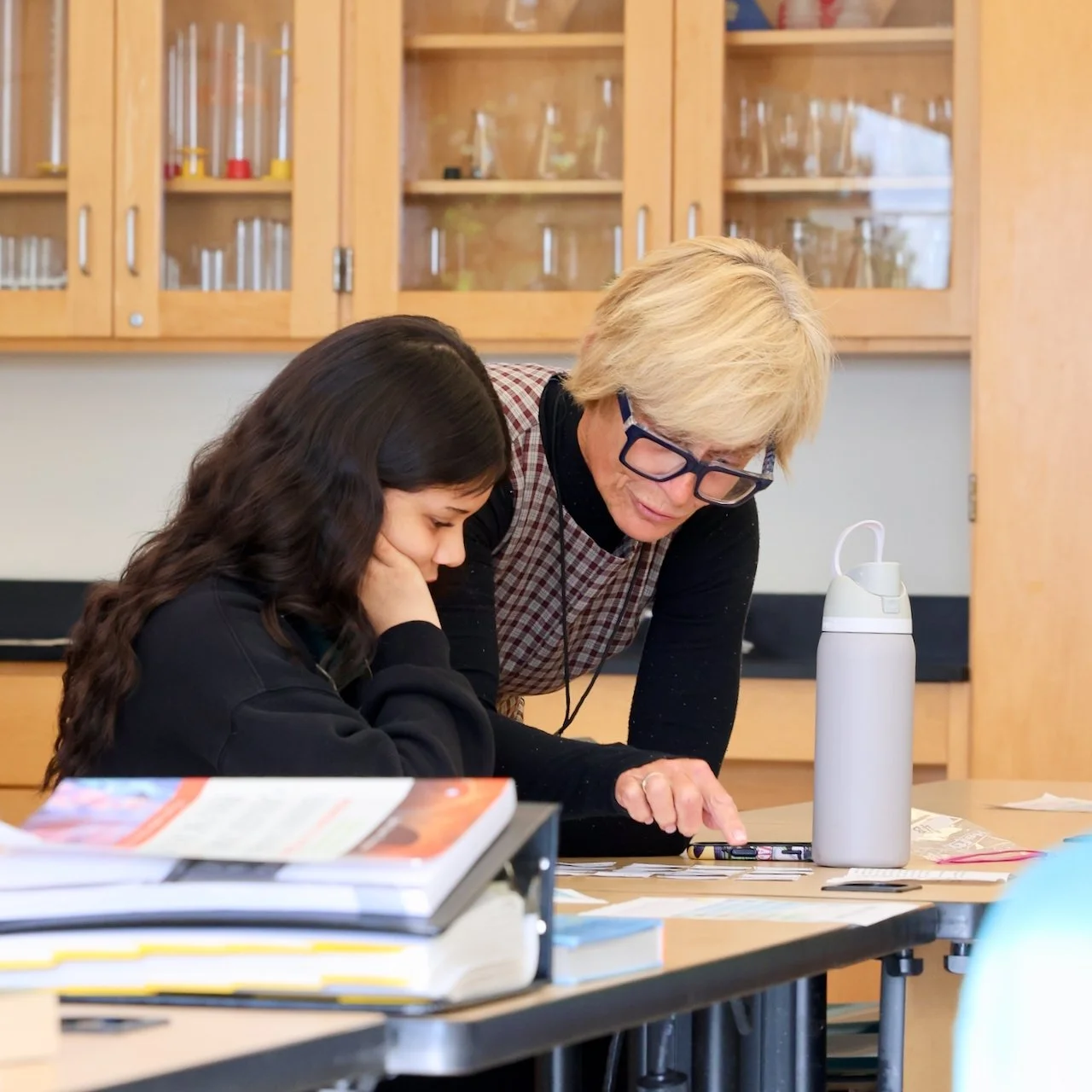
DEDICATED AND CARING FACULTY
At no other time in a young woman’s life will there be so many caring educators invested in her success and who are eager to help her reach her highest potential. Our teachers bring diverse perspectives and experiences that develop students who are global citizens.
• 68% hold advanced degrees
• Over 70% faculty live on campus
-
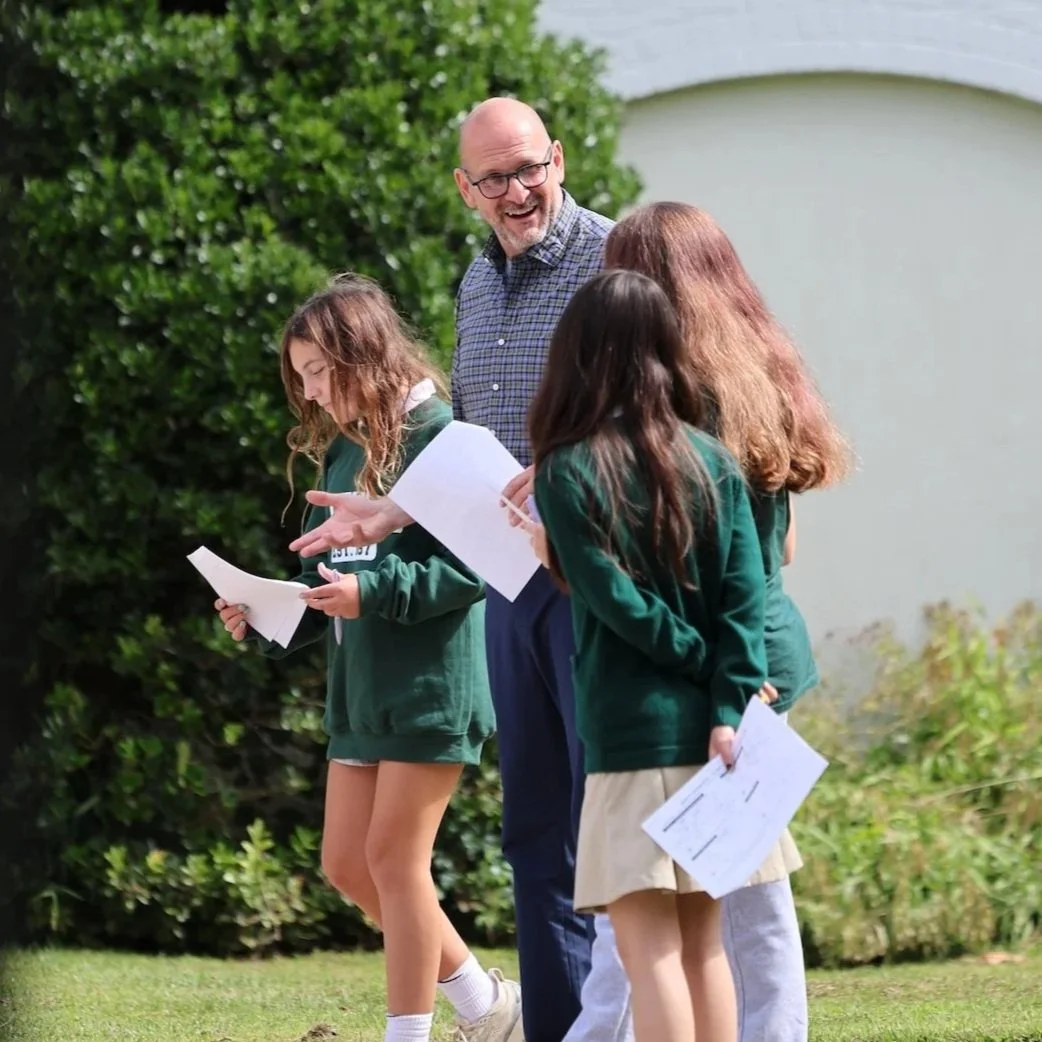
CHALLENGING AND FLEXIBLE ACADEMIC CURRICULUM
Each girl’s success means crafting an academic path that fits each girl’s interests and challenges her intellect. Our advisors work with each girl, her teachers, and her family to plan out an appropriately challenging and personalized academic path. At Oldfields, we develop capable, confident young women who are prepared to succeed and lead in college and beyond.
• College Preparatory Curriculum
• Learning Support
Academic Support
SMALL CLASS SIZE provides students with more access to their teachers and allows for 1:1 check-ins during the class period.
EXTRA HELP TIME is built into our schedule when each faculty member is available to work with students.
EVENING STUDY HALL takes place Monday through Thursday evenings with different levels of structure based on student’s needs and/or grade level.
PRIVATE TUTORING is available at an additional cost, with experienced tutors who are able to work with students on campus and provide content based support.
OLDFIELDS ACCOMMODATIONS PLANS (OAP) offer a structured guide, that includes academic accommodations and recommendations for students with documented disabilities. The OAP helps to ensure a student has the necessary accommodations inside the classroom and complies with the regulations stipulated by Educational Testing Service and ACT.